Mike Teavee–Mr and Mrs Teavee
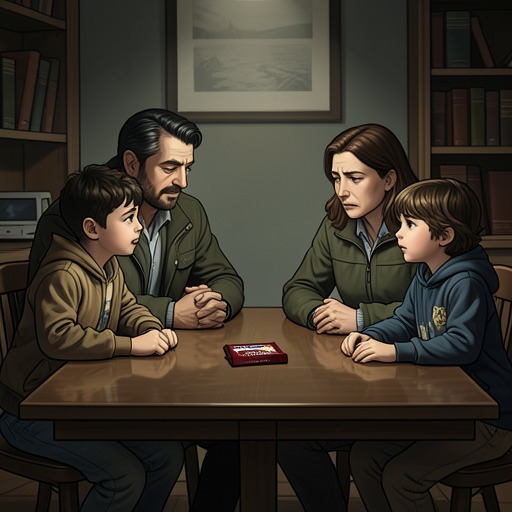
Charlie and the Chocolate FactoryMike Teavee–Mr and Mrs Teavee is one of the book's clearest portraits of a family organized around television. Mike Teavee treats the screen as more important than conversation, manners, safety, or even his parents' commands; Mr and Mrs Teavee respond with a mixture of exasperation, alarm, and belated resistance. Their relationship reaches its decisive crisis in the Television-Chocolate Room, where Mike ignores warnings, enters Willy Wonka's experimental television apparatus, and returns as a tiny figure. The parents' attempt to rescue and control him reveals both their attachment to their son and the weakness of the authority they have previously allowed him to evade.
Family Identity and Introduction
Mike Teavee is introduced through a newspaper account of the fourth Golden Ticket, which identifies him as a nine-year-old boy and presents his household as crowded with visitors celebrating his win. Yet Mike himself is not participating in the excitement. He is seated before an enormous television set, his eyes fixed on the screen, and reacts to the reporter's arrival as an interruption rather than as a family occasion. His first defining relationship is therefore not simply with Mr and Mrs Teavee, but with the television that occupies the center of his attention.
The newspaper describes Mike's parents as present in the household but unable to command his attention. While visitors gather around the ticket winner, Mike angrily tells them not to interrupt him. His speech is dominated by the program he is watching, especially its scenes of gangsters shooting one another. The family's public moment is displaced by private viewing: the Golden Ticket, which should make Mike the focus of the room, cannot compete with the screen.
Mike's costume and physical behavior turn his fascination into a visible family condition. He wears no fewer than eighteen toy pistols of different sizes around his body, leaps into the air, and fires them while watching the film. The toy weapons imitate the violence on television, making the screen's imagery portable and performative. Mike does not merely watch violence; he rehearses it in the presence of his parents and visitors, while the adults remain unable to stop the performance.
Television as the Family's Rival
Mike's language shows that television has become the principal authority in his life. He says that he watches every day, including programs he considers poor, and reserves particular enthusiasm for gangsters and their weapons. His excitement is directed toward fictional violence rather than toward the people physically around him. Even his parents' attempts to speak are treated as annoyances, and he repeatedly demands silence so that the program can continue uninterrupted.
Mr and Mrs Teavee occupy contrasting positions within this pattern. They are responsible for the child, but they do not initially redirect his attention or challenge the habits that have made the screen so powerful. When Mike later interrupts Willy Wonka to ask about Television Chocolate, Mr Teavee snaps at him to stop interrupting. The command is immediate and parental, but it also echoes the rule Mike himself has imposed at home: speech must yield to the screen or to the spectacle being discussed.
Willy Wonka explicitly identifies the danger behind this domestic arrangement. He says that he dislikes television and considers it acceptable only in small doses, while children, in his view, want to sit staring at it all day. Mike immediately claims that this description applies to him. The admission is almost boastful: what an adult identifies as excess has become, for Mike, a point of self-definition. Mr Teavee's response is again a sharp order to be quiet, but the exchange suggests that reprimand alone has not altered the pattern.
The relationship also becomes part of the crowd's public knowledge. Outside Wonka's factory, spectators identify Mike as the television fiend and point out the toy pistols hanging all over him. Mike and his parents arrive not as an ordinary family but as a recognizable spectacle, with the boy's addiction functioning as his public label. The parents' association with him makes their failure to restrain him visible before the factory tour even begins.
The Television-Chocolate Crisis
In the Television-Chocolate Room, Willy Wonka presents Television Chocolate as his latest and greatest invention. The room contains an enormous black camera, suited Oompa-Loompas moving carefully around it, and another Oompa-Loompa watching a large television screen from a distant table. The apparatus is designed to send a chocolate bar through television so that it appears on a receiving screen in a reduced form. Wonka imagines a commercial future in which viewers could reach out from home and take a Wonka chocolate directly from the screen.
Mike's question about the invention quickly becomes a question about whether a person could be transmitted in the same way. Wonka warns that he does not know what would happen and admits that the results might be very unpleasant. Mr and Mrs Teavee therefore receive a clear warning at the moment when their son begins to test the machine. The danger is not hidden from them, and Mike's subsequent action is not an accidental misunderstanding: he hears that the process might be possible and immediately decides to make himself the first person sent by television.
Mike runs toward the great camera despite Wonka's repeated protests. Mrs Teavee screams for him to stop and warns that he may be turned into a million tiny pieces. Her warning expresses direct fear for his bodily safety, while Mr Teavee is present within the same emergency as the machine's danger becomes real. Mike nevertheless reaches the apparatus, scatters Oompa-Loompas, pulls the switch, and leaps into the full glare of the lens. A blinding flash follows, and the place where he stood is suddenly empty.
The parents' relationship changes in an instant from irritated supervision to desperate search. Mrs Teavee runs forward, stops, and stares at the empty space before screaming that Mike is gone. Mr Teavee confirms the disappearance, while Willy Wonka places a hand on Mrs Teavee's shoulder and tells the family that they must hope the boy comes out unharmed at the other end. The scene converts Mike's earlier desire for television's power into a parental crisis: the medium that had absorbed his attention has now taken his body beyond their reach.
Recovery, Shrinkage, and Parental Control
Mike eventually appears on the television screen, standing, waving, and grinning. The return is not a restoration of normality. Mr Teavee immediately recognizes that Mike is a midget, and Mrs Teavee asks whether he is all right and whether any parts of him are missing. The parents' first concern is physical survival, but the image also confirms that the apparatus has changed the scale and condition of their son.
Mike himself interprets the result as a triumph. In a tiny voice, he greets his parents and announces that he is the first person ever to be sent by television. His pride shows that the accident has not yet weakened the desire that caused it. Even after being reduced to a figure small enough to be taken from the screen by hand, he treats the experiment as an achievement rather than as a warning.
Mrs Teavee picks him out of the screen, and the family must now deal with the consequences as a bodily problem. Mr Teavee says that Mike cannot return to school in this condition because he could be trodden on or squashed, while Mrs Teavee cries that he will not be able to do anything. Mike rejects their fears and insists that he will still be able to watch television. The contrast is stark: the parents measure his condition by vulnerability and lost ordinary capacities, whereas Mike measures it by whether access to the screen remains possible.
Mr Teavee then declares that he will throw the television set out of the window as soon as they get home and that he has had enough of television. This is his strongest attempt to reassert parental authority. It is also a reversal: before the accident, television was tolerated as part of family life; after the accident, Mr Teavee treats the set itself as something that must be expelled from the household.
Mike responds with a violent tantrum. He jumps up and down on his mother's palm, screams, yells, and tries to bite her fingers while repeating that he wants to watch television. Mrs Teavee becomes the immediate physical support for the child, but Mike turns even that protective contact into a struggle against restraint. Mr Teavee takes him from her, puts him into the breast pocket of his jacket, and covers him with a handkerchief. Mike's squeals and yells continue from inside the pocket as he fights to escape, so the parents' attempt to protect him also becomes an attempt to contain his compulsive desire.
Dependency, Responsibility, and Meaning
Mrs Teavee's next concern is how to make Mike grow again. Her question places responsibility for repair before Willy Wonka, whose experiment has exposed the family's dependence on an inventor and his machinery. Wonka proposes using a special machine intended to test the stretchiness of chewing gum, reasoning that small boys are springy and elastic and may stretch back to their former size. The remedy is itself experimental, so the parents' rescue depends on another technological process rather than on a simple return home.
Mr and Mrs Teavee's conduct is protective but reactive. They warn, question, seize, pocket, and seek a cure only after Mike has acted. Mike, meanwhile, treats parental concern as an obstacle whenever it threatens his television access. Their relationship therefore dramatizes a cycle in which indulgence permits addiction to grow, addiction produces danger, and danger prompts an emergency assertion of control that the child immediately contests.
The Oompa-Loompas' song, beginning with the claim that the most important lesson concerning children is never to allow a certain behavior, places Mike's family crisis within the book's wider moral pattern. The song does not isolate the event as a freak accident; it presents the incident as evidence of a lesson about children's habits and adult responsibility. Mike's parents love and protect him, but their authority is repeatedly forced to follow the behavior it should have governed. The final image of the tiny, furious boy still demanding television makes that failure unmistakable: even after the medium has transformed him, he remains attached to it, while his parents are left to manage the physical and moral consequences.